

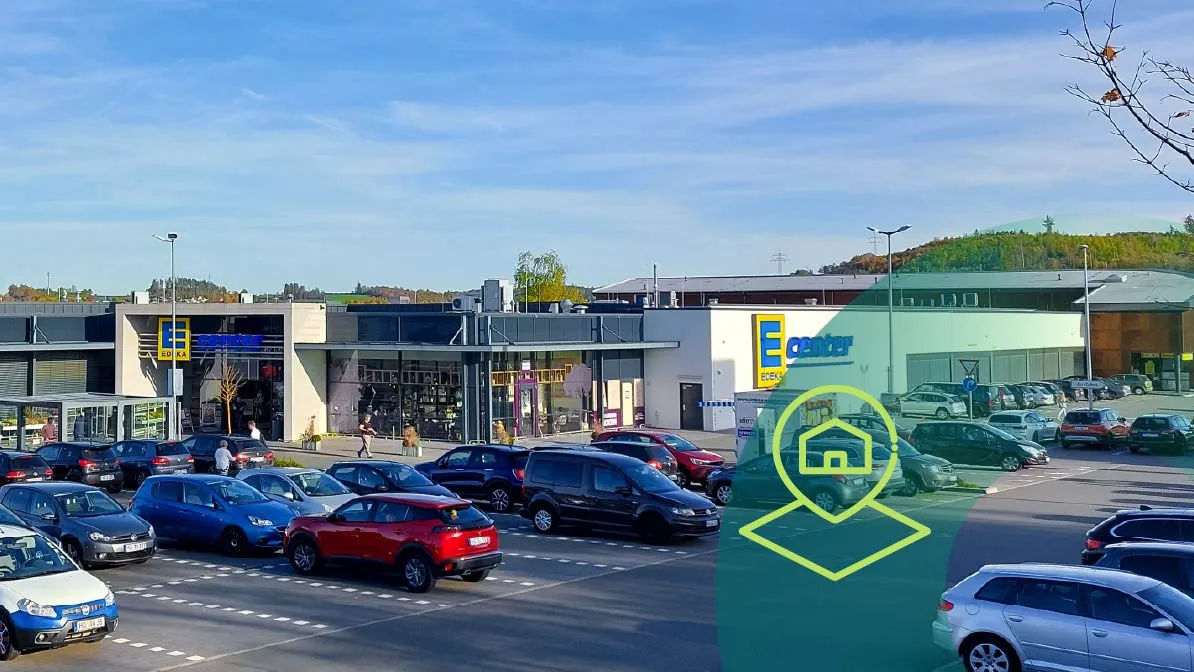
Both of Greenman’s Real Asset funds, Greenman OPEN and Greenman NEXT acquire real estate that is anchored by supermarkets. These supermarkets are leased to the grocery retailers that households visit several times a week. Here we will focus on EDEKA, one of the most familiar household names in Germany and one of Greenman OPEN’s largest tenants.
Walk into an EDEKA almost anywhere in Germany and the first thing you notice is the counters. A butcher cutting meat to order, a large and well stocked cheese counter, fresh bread from their in-house backer, and aisle after aisle of choice. A large store can stock around 20,000 products. This is not a quick, in-and-out discount shop. It is the weekly shop done properly, and it is one of the tenants at the heart of Greenman OPEN’s portfolio.
Behind many of those stores is a local owner. EDEKA started more than a century ago as a buying co-operative of independent grocers in Berlin, and it has never lost that spirit. Today around 3,200 independent retailers run more than half of its stores as their own businesses. The person running the local EDEKA is often the person who owns it.
However, the scale behind that local feel is enormous. In 2025 the EDEKA group turned over €77.3 billion across 10,871 stores, and employed around 417,500 people. Deloitte ranks it 17th among the world’s retailers, ahead of LVMH, even though it trades in just one country. In Germany, almost one in every two supermarkets is an EDEKA.
And that one country is quite a market. Germany is the EU’s most populous nation, with around 83.5 million people, and spends roughly €246 billion a year on groceries, more than any other market in Europe. It is home to some of the biggest grocers in the world: alongside EDEKA, the Schwarz Group (owner of Lidl and Kaufland), Aldi and Rewe all rank in the global top 20.
And people keep buying food, whatever the economy they always need to eat. Through the food price spike of 2022 and 2023, German grocery sales kept growing: people changed what went into the basket, not where they shopped. Online grocery is still only around 0.4% of the market, so the weekly shop still happens in store.
For a landlord, the question isn’t whether people will keep buying food, but where they will buy it. In Germany, the answer is very often EDEKA.
Important Note
This update is for information purposes only. Shareholders in any Greenman fund are not required to act upon any of the information contained in this update.
This update may include forecasts, forward-looking statements, and estimates. There is a significant risk that targets and milestones mentioned in this update may not be met or may not be met in the expected timeline, and the performance of Greenman funds may be affected if these targets are not met.
This update also may include current and historic information. Historic data and therefore past performance is not a good predictor of future performance.
Nothing in this update should be considered as investment advice or as a recommendation to invest.
Further Information
If you would like further information, please feel free to contact our investor’s team at enquiries@greenman.com.